Invest a Lump Sum or Dollar-Cost Average?
Q: I received a lump sum of money, should I invest it all at once or invest it over a period of the next 12 months?
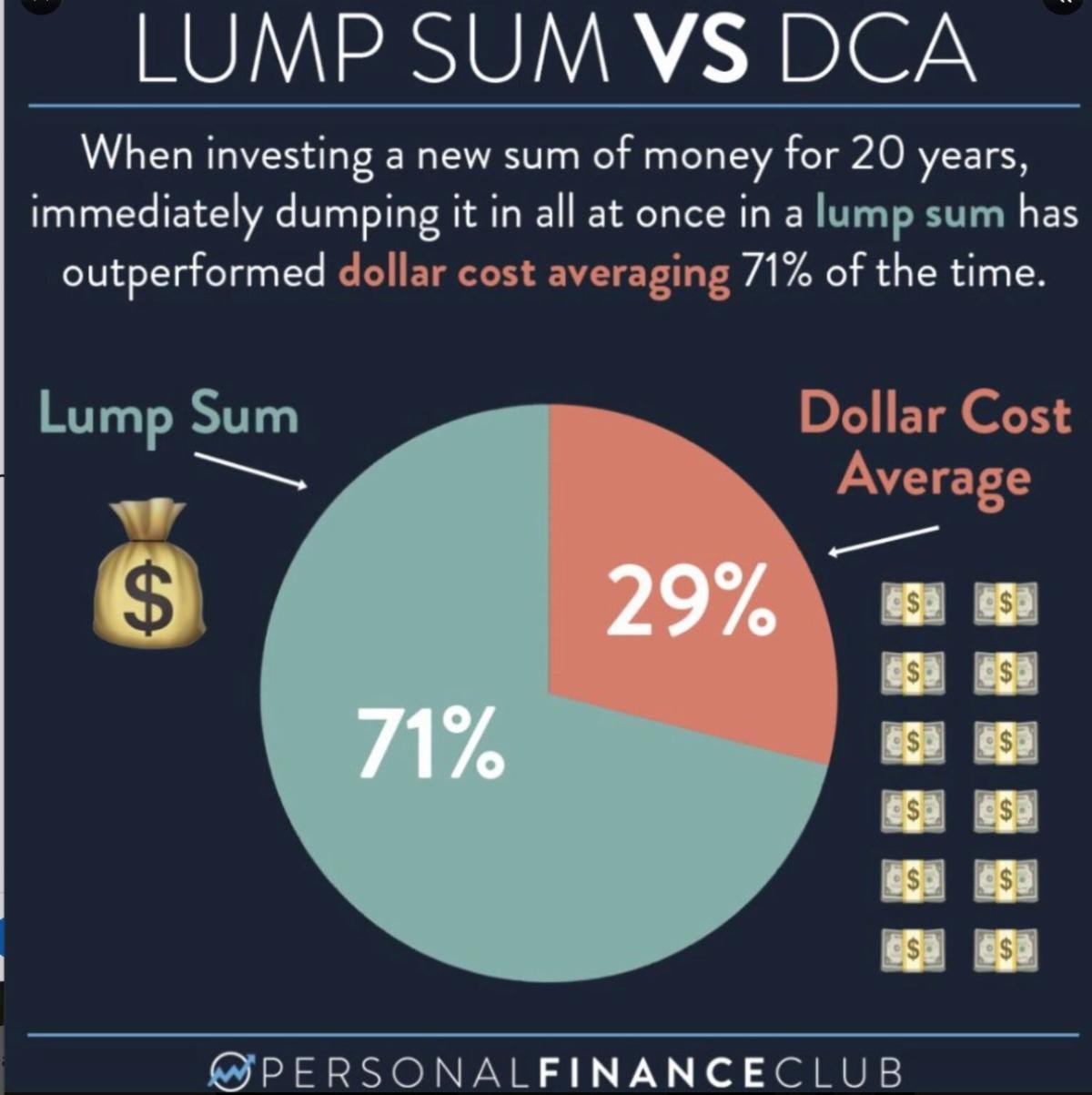
Here is how I think about it:
From a mathematical standpoint, you can see from the graphic below that investing the money upfront via lump sum works in your favor 71% of the time vs dollar cost averaging. Dollar cost averaging is referring to investing the money over a set period of time such as 12 months.
For example: If you have $120,000 in cash, investing it all at once has a 71% chance of being worth more over time compared to investing $10,000 monthly over 12 months.
Time in the market generally outperforms timing the market.
Another way to think about it: if you left your employer and rolled over a $500,000 401k to an IRA, wouldn't you invest the entirety of the funds immediately given the money was already invested?
That being said, I can understand how dollar-cost averaging can feel less risky due to market volatility. If you choose to dollar-cost average, consider parameters like investing the remainder if the market rises or falls 10%. Q: The market just hit an all time high, is now a good time to invest?
In the chart below we see the following:
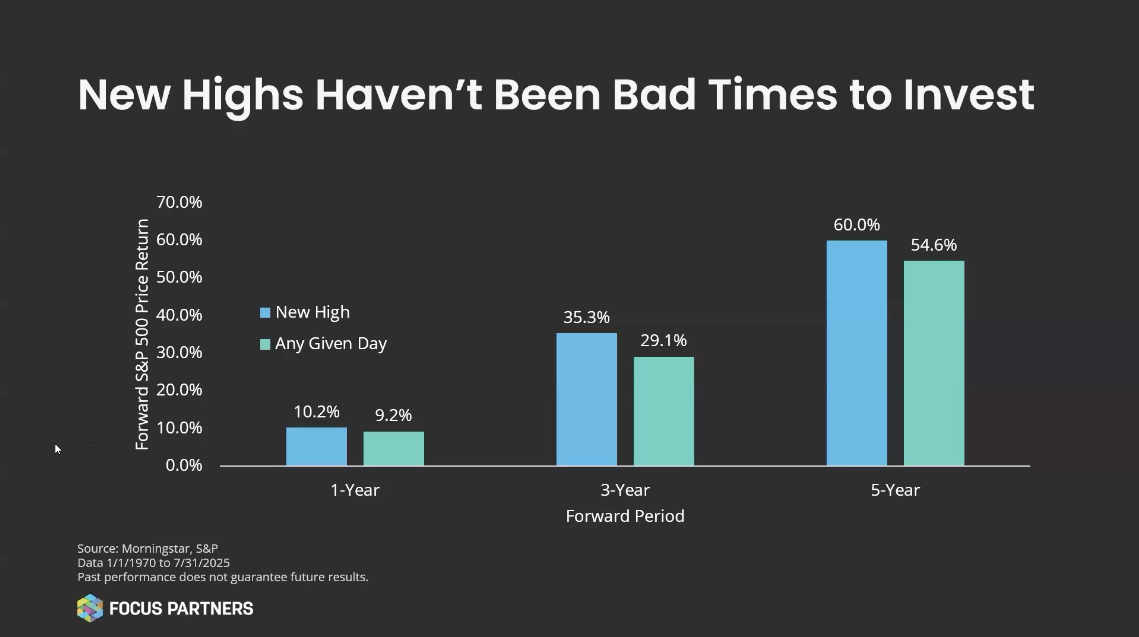
When a new high is achieved, the market has averaged a 10.2% return 1 year later vs 9.2% on any random day.
When a new high is achieved, the market has averaged a 35.3% return 3 years later vs 29.1% on any random day.
When a new high is achieved, the market has averaged a 60% return 5 years later vs 54.6% on any random day.
Q: What should I do with my student loans after the passing of the new bill?
Here is what you need to know:
SAVE, PAYE, and ICR plans will sunset. New Repayment Assistance Plan (RAP) offers forgiveness after 30 years for non PSLF borrowers but isn't available until July 2026
If you’re pursuing Public Service Loan Forgiveness (PSLF) or income-driven repayment (IDR) forgiveness:
Payments in SAVE’s current forbearance status will not count toward forgiveness, you need to consider switching to another IDR plan to have payments count towards forgiveness
Repayment options depend on when you first borrowed:
Before October 2007 – Old IBR: 15% of discretionary income; spouse’s income excluded if filing separately. October 2007–July 2014 – PAYE: 10% of discretionary income; lock in before it sunsets in 2028 After July 2014 – PAYE or New IBR: 10% of discretionary income; New IBR offers more long-term flexibility. Parent PLUS borrowers: consolidate before July 1, 2026, to access IBR and avoid being locked into the 10-year standard plan.
The New RAP Plan RAP launches by July 1, 2026, for new borrowers. Payments start at $10/month, rising to 10% of AGI above $100,000. Offers interest waivers and small principal credits. Forgiveness after 10 years for PSLF, 30 years for IDR. Married Filing Jointly households pay based on total combined income
Sources: Congress.gov., savingforcollege.com, the American Enterprise Institute, the College Investor, studentaid.gov, the Education Department, and Forbes.
Historical article · Originally published September 2025. Market data and tax rules reflect the original publication date. Past performance is not a guarantee of future results. Editorial and compliance review pending.