Market Volatility and the Value of Staying Invested
Hello,
As I was writing my newsletter for this week, I’ve had to change it nearly every day. As with all things, there is a price of admission. The price of admission to great stock market returns is: volatility.
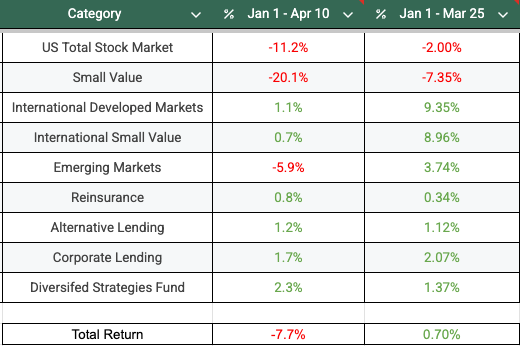
I updated you on March 25th that despite the chaos, a diversified portfolio was still up about 0.70% so far this year.
As I write today, after market close April 10th, that same portfolio is now down about 7.7%. I've put the chart below.
This statistic is worth reviewing every day in times like these: At some point throughout every year the AVERAGE intra-year decline of the stock market has been around 14% per year, yet the market still returns positive on the year 70+% of the time.
Where are we at right now? The US Total stock market is down about 11% on the year. If you watch the headlines you would have thought your entire portfolio was wiped out by now, and yet we haven’t even hit the AVERAGE intra-year decline.
If we zoom out, the 1 year return is 0.94%. The 5 year return is about 85% or 17% PER YEAR.
Another reminder:
For those NOT in retirement: If you are still saving money for retirement, a market drop is a blessing. Plain and simple, you should want the market to go down so you can buy more shares of great companies at a lower price.
For those IN retirement: If you are in retirement, I wouldn’t call a market drop a blessing – however, nearly every quarter your investments are receiving dividends and if the market has dropped those dividends are scooping up more shares at lower prices every quarter. But the other thing to keep in mind is, our clients in retirement have CDs and/or Treasuries locked in at 4-5% rates that will cover their expenses for the next 3-5 years. By the time that money runs out, the market should recover like it has nearly every time before.
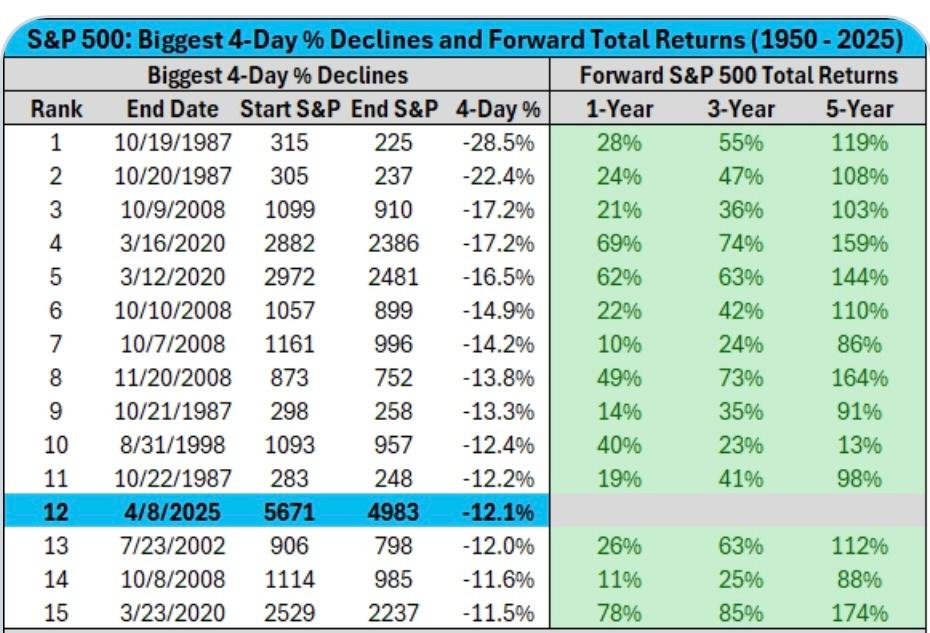
On that topic, this chart illustrates just that: Strategies we implement(ed)
Tax Loss Harvest: If a fund was down $5,000 or more we sold and re-bought a similar fund to capture losses to either offset capital gains and/or deduct up to $3,000/yr as an income tax deduction, which if the loss was greater than $3,000 it carries forward indefinitely until exhausted
The timing of this worked out well as the market had been doing down up until Tuesday April 8th. On that day, we captured some losses but we were right back in the market that same day. On April 9th, we saw the 3rd largest increase in the history of the market, so those funds still benefited from capturing the loss as a write off now, but also still reaping the reward of the gain.
If you are doing this on your own, just be very careful of not waiting too long after you sell. Worst case is someone who sold on Tuesday, then wasn't able to buy back in on Wednesday and missed the 3rd largest gain in market history.
Rebalance the portfolio. If funds drift from our preferred %s, we will buy more of the funds that are lower right now and potentially sell some of the funds that are high now, being mindful of capital gains.
As always, I’m here for any questions.
Thank you for being a valued client and/or reader of this letter.
Historical article · Originally published April 2025. Market data and tax rules reflect the original publication date. Past performance is not a guarantee of future results. Editorial and compliance review pending.